Emissions, Food Security and the Economic Costs of a Warming Climate.
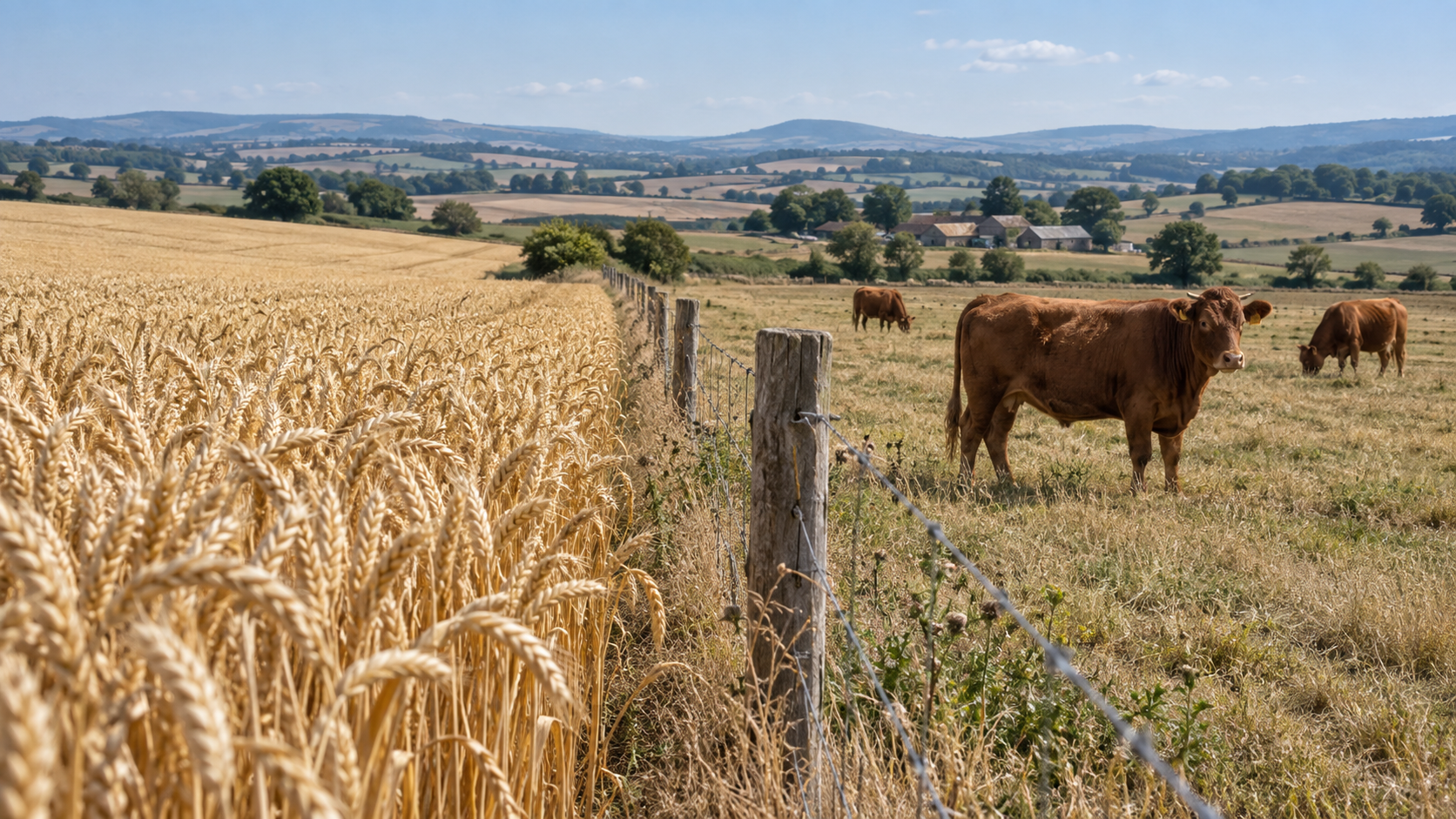
Beef has a far greater climate footprint than wheat. Yet wheat’s exposure to rising temperatures poses a critical challenge for food security. This distinction matters for climate strategy: the products that generate the most emissions are not necessarily those facing the greatest production losses.
In this paper, we examine both sides of that relationship. Where should we prioritise emissions reductions, and where is adaptation most urgently needed to protect food production?
The worst-affected staples are not the highest emitters
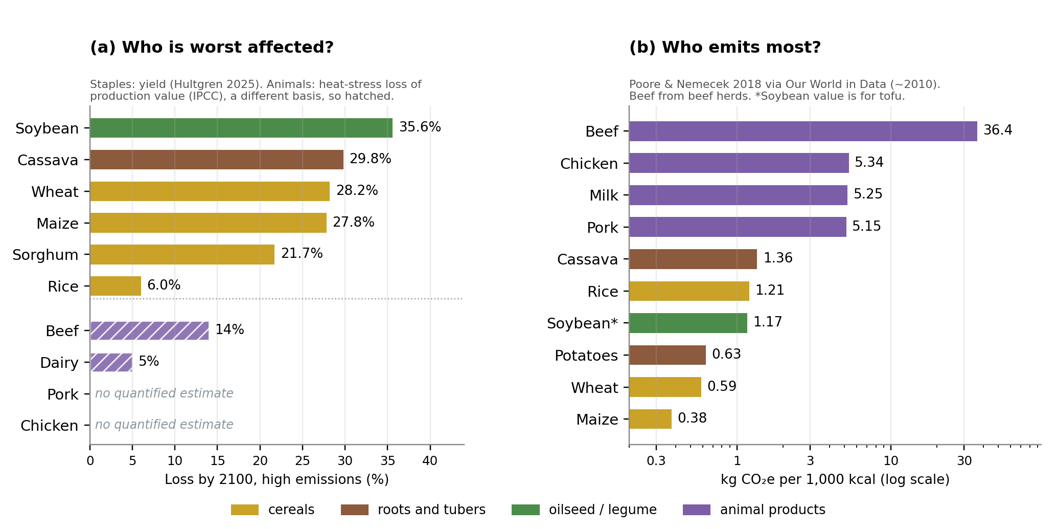
Hultgren et al. (2025); IPCC (2022); Poore and Nemecek (2018) via Our World in Data; Vision analysis.
The comparison reveals why a single ranking cannot guide every decision. Beef stands out for its emissions, while essential staples face substantial projected losses. Among the five staples for which we have global estimates per degree of warming, wheat and maize account for roughly four-fifths of the calories at risk. Their importance to food supply changes the priorities that emerge from percentage losses alone.
We bring together evidence on ten major staple foods and four animal products, examining production losses, adaptation costs, changes in quality and market effects. Geography is central to the analysis. In South Asia and sub-Saharan Africa, exposure to heat and dependence on rainfed farming often coincide with limited resources to adapt. Elsewhere, irrigation, investment and shifts in suitable growing areas can provide partial protection. The same degree of warming therefore carries very different consequences for farmers and consumers.
Our initial calculation puts around USD 47 billion in annual production value at risk per degree of warming across five staples. This static estimate excludes price responses, adaptation and substitution between crops. It also leaves a less visible cost uncounted: a harvest can retain its volume while losing nutritional quality or market value.
Agrifood climate strategy must connect emissions, vulnerability and economic consequences. Examining these together provides a clearer basis for deciding which risks to address, which producers and regions need support, and where further evidence could change investment priorities.
The study was conducted by:
Francesco Grillo, Vision Director
Linus Wendel, Vision Associate
Shrikant Bacha, Vision Associate