Risk Assessment, Prevention and Partnerships to Close the Climate Protection Gap and the Future of Insurance
Climate change is challenging the relationship between insurance and risk. As losses rise, helping households and businesses recover increasingly depends on helping them withstand shocks in the first place. We see a commercial opportunity in connecting better risk information, practical prevention and effective partnerships to extend sustainable coverage.
Insurers face pressure from both the frequency of natural catastrophes and their cost. Between 2000-2014 and 2015-2023, the average annual number of recorded disasters rose from 386 to 427, while average economic losses per event increased from USD 0.75 billion to USD 0.89 billion. Floods, wildfires and severe convective storms often described as secondary perils-accounted for roughly 70% of the increase in losses.
Changes in natural catastrophe frequency and average economic loss per event
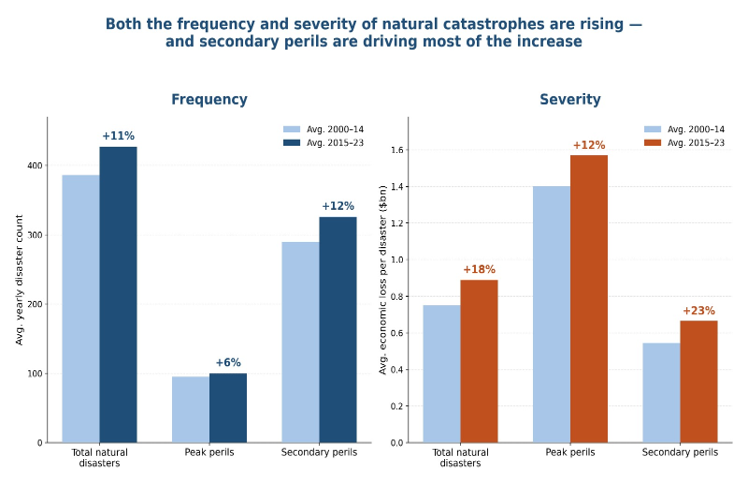
McKinsey & Company, “How to make the world insurable again?”, Venice Conference on Climate Change, October 2025. Historical losses adjusted using the US Consumer Price Index.
The resulting protection gap is substantial. Over 2015-2024, around 60% of global natural catastrophe losses were uninsured, rising to approximately two-thirds in Europe. These figures include earthquakes but exclude droughts and heatwaves. Using a different measure that includes those weather-related extremes, the European Environment Agency estimates that less than 20% of EU losses from climate-related extremes between 1980 and 2024 were privately insured.
Share of natural catastrophe losses uninsured worldwide and in Europe
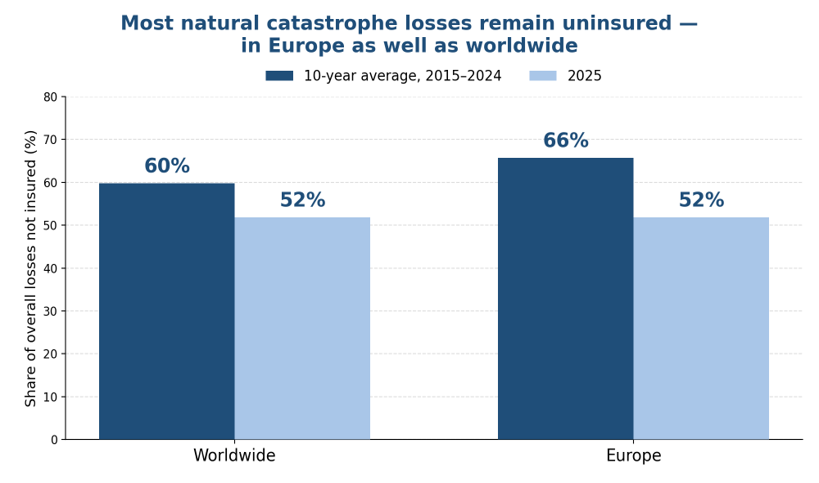
Munich Re, natural disaster figures for 2025, published January 2026. The figure compares the 2015–2024 average with 2025; droughts and heatwaves are excluded.
These pressures are unevenly distributed. In the United States, homeowners’ non-renewal rates increased from 0.8% to 1.1% between 2018 and 2023, with rates in high-risk ZIP codes around 80% higher than in low-risk areas. The consequences extend beyond insurance: evidence from Florida links insurer fragility to worse mortgage delinquency after a hurricane. Protecting a property’s insurability therefore matters to lenders as well as owners.
Why does coverage remain difficult to obtain even when capital is available? Higher premiums compete with constrained household budgets, while exclusions and larger excesses can reduce the value customers perceive. For insurers, expected losses, rebuilding costs and concentrated exposure determine whether cover is commercially sustainable. More capital can help, but prevention and affordability remain essential.
We propose a model connecting individual risk assessment, tailored underwriting and verified prevention. Two neighbouring buildings may have very different vulnerabilities because of elevation, drainage, construction or maintenance. AI can combine building records, imagery, sensors and hazard information to identify these differences at scale. This could reveal a resilient property within an otherwise difficult area—or an improvement that would make coverage viable.
The assessment must lead to a practical offer. Customers should understand what cover is available now, which improvements matter, how they can be financed, and what insurance benefit follows verified completion. That benefit could take the form of a discount, a lower deductible or a higher coverage limit.
Existing programmes provide useful precedents. Strengthen Alabama Homes connects property evaluation, contractor bids, grant support and verification. Flood Re’s Build Back Better enables participating insurers to fund eligible flood-resilience measures after a claim. A study of more than 40,000 insured properties exposed to Hurricane Sally found claim frequency 55–74% lower for the FORTIFIED standards studied than for conventional homes, providing evidence for testing prevention’s value in other portfolios.
Trust is central to this approach. We propose an independently governed data layer that supplies validated risk assessments while limiting insurers’ routine access to underlying monitoring records. A portable record of verified improvements would also help customers demonstrate resilience when changing insurer or seeking finance. Clear explanations, reliable evidence and opportunities to challenge errors would support confidence in the process.
For insurers, the commercial benefit is strongest where prevention reduces claims they would otherwise pay. Verified improvements may also support negotiations with reinsurers where they reduce the risks being transferred. Public support remains important where prevention is unaffordable or losses are too concentrated. Its design should distinguish support for unavoidable risk from repeated subsidies for damage that feasible measures could reduce.
The opportunity extends beyond property. Our European segmentation identifies two potential markets: an estimated 22.2 million affluent young adults with low propensity to insure, and 34.4 million people approaching later life who may seek lifelong protection. These are modelled populations, not forecasts of policy sales. We explore products combining long-term saving with protection against interruptions to working life, and continuing health coverage with appropriate care and condition management.
Across these markets, the question is the same: can helping customers manage their risks make better protection commercially sustainable? Our paper examines the partnerships, incentives and safeguards needed to turn that proposition into a lasting insurance relationship.
The study was conducted by:
Francesco Grillo, Vision Director
Rithika Clifford, Vision Associate
Linus Wendel, Vision Associate