
Europe’s promise tested by power, investments and fragmentation
Across the EU the 2024 electoral campaign mirrored different views on wars and immigration, on whether Europe should issue common debt and on how quickly should we reduce CO2 emissions, on the right quantity of regulations of digital and on the positionof the block in a world which is lookingfor a new order.
Yet most of the political sides and public opinions would agree that these radically new challenges Europe faces, require us to rethink the institution that was conceived by Europe’s fathers eighty years ago with the main objective to avoid new, catastrophic wars.
The Bad...
First, let's start with the most worrying part.
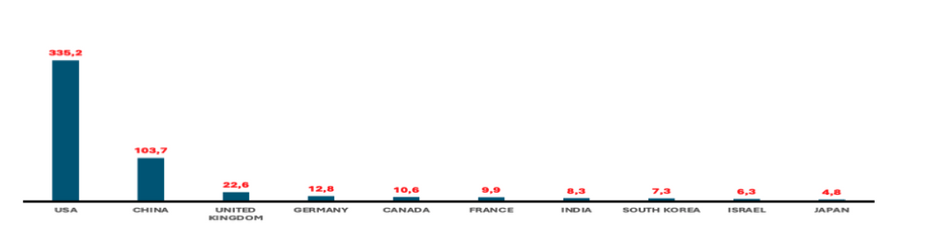
The graph below comes from the yearly AI INFDEX report that Stanford University dedicated to the advancement of the technological wave which is meant to change radically industries and governments
Chart 1: Private investment in AI by geographic area, 2013-2023 (Billion USD)
Source: Vision on Stanford University and QUID Data
The battle for leadership of AI supremacy seems to be a two-horse race between USA and China. Three days before the Siena Conference, Mario Draghi mentioned that the EU will need to mobilize about 800 billion USD of additional investments. Looking more specifically to what kind of investments we need, the private spending on AI is an important indicator.
Only two EU countries (Germany and France) are amongst the top 10 in terms of mobilizing private investments (which is arguably the best indicator of success even for industrial policy). Stillthey managed to attract less investments than UK in the last ten years ; and yet if you combine UK, Germany and France, it still accounts for less than half of Chinese private investment into AI and less than a sixth of what the US private investors have invested.
The consequences of this lack of this kind of investments are rather profound and are reflected on geopolitical dominance of leading-edge research: currently 109 foundation models (they are rather representative of the frontier) are owned/ designed by US organizations (mostly private companies and with a clear lead of Alphabet); 20 from Chinese ones; and only 5 from the EU.
The gap is – as we mentioned in the conceptpaper of past editions – based on the entire digital value chain. It is also reflected in the value of European companies: as of June 2024, the capitalization of the entire Frankfurt Stock Exchange(where about 500 companies are listed including Sap, Siemens, Adidas, Bayer, Deutsche Bank, Volkswagen and Porsche) is slightly bigger than half of the value of just Apple.
Of the world’s 160 listed firms worth over $100bn, 45 areless than 50 years old: 32 in America and 9 in China. Only one is in Europe: ASML, a Dutch software group founded in 1984. ASML is also the most remarkable demonstration that Europe can still produce innovative new technologies and be a world leader: it is the sole supplier in the world of extreme ultraviolet lithography (EUV) photolithography machines that are required to manufacture the most advanced chips.
The problem is that digital technologies are not just about competitiveness. Likewise, we are not just witnessing an industrial revolution, because this is more like a biological mutation where our very cognitive processes are being transformed. The internet is – just like Gutenberg’s printing machine at the end of the middle-ages – massively reallocating information. And since information is power, technologies are redistributing power between states and private companies; citizens and states; different economic segments; amongst countries. Technologies are even changing wars and are radically transforming what shouldwe do to protectour values from aggressions (in Ukraine, for instance) and the way we should equip ourselves so that we give peace the best chance.
... the Good
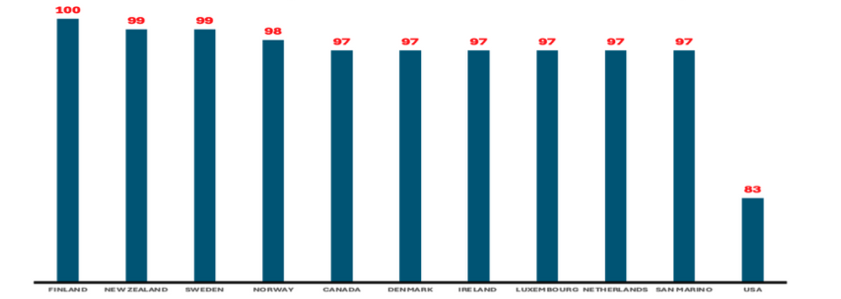
Europe, however, has still got some features that must be seen as competitive advantages. It is certainly still the part of the world where freedom is more abundant. Amongst the top 10 countries in the ranking of “Freedom house”, seven out of the ten most free countries are from the EU.
Chart 2: Degree of civil liberties and political rights in different countries (Ranking, from 0 to 100, 2023)
Source: Vision on Freedom House data
Freedom is meant to be not only per se one of the most important factors of quality of life; but also, an important precondition to growth. If individuals have the possibility to represent their needs; provide feedback to whom exercises power; and lend their individual intelligence to policy making, societies should increase their capabilities to allocate scares resources to the best use. Information should then be a competitive advantage of countries which are free (and open). We will, however, see that for complex reasons that Europe should investigate, this mechanism that led “open societies” to win againstauthoritarian regimes is broken.
Freedom is also simplyone of the characteristics that attract people, and Europe does host some of the most livable cities. It is a question of rights, of healthcare, welfare, affordable prices and environment (the European Union is reducing its CO2 emissions at a much faster speed – 25% since the first COP in 1995). Europe is still the place where an ever-increasing number of individuals (1.3 billion in 2023) moving for leisure, want visit.
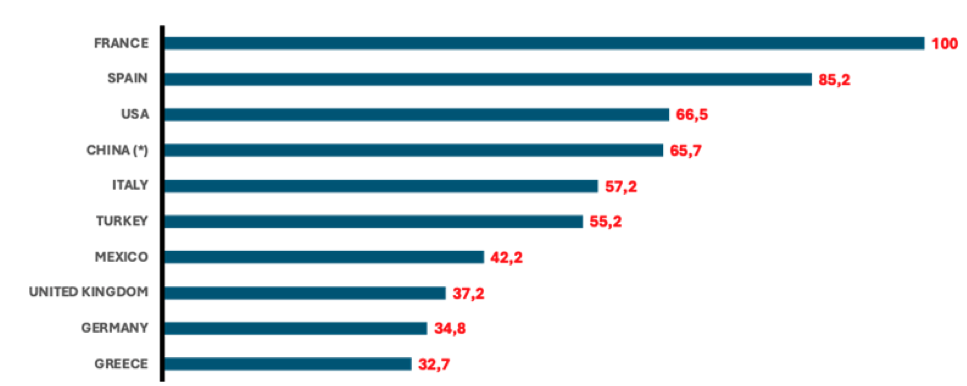
Chart 3: Number of international tourist arrival, 2023 (in million people)
Source: Vision on UNWTO data
Three of the five top destinations are in the EU; and five of the top ten.
Europe is still by far the market leader and it is not, however, just about the leadership into an industry which is important but still believed to be not highly productive. It is about having an advantage in terms of producing symbols that can still be crucial in a society dominated by algorithms Beauty may be what robots may not be capable to reproduce and it is the symbol upon which France has built three (LVMH, L’OREAL and Hermes) of the five largest European companies by market value.
The Siena Conference will dedicate a session to how to endure and scale up the advantage that we may have to produce symbols and, again, it will be clear that this is not just a legacy of the past: but it requires a lot of innovation (different but not less challenging than working on foundation models).
... and the Ugly
Ursula Von Der Leyen is right to have in her own mission - the protection of the European “style of life”. It is a something of value worth our energy and ideas .Yet having Europe being left behind will mean automatically have Europe to leave behind parts of its society. This may ultimately make our “style of life” not defendable. It is something that may be already happening if we consider the inequality (in space) amongst European regions (as for the chart below).
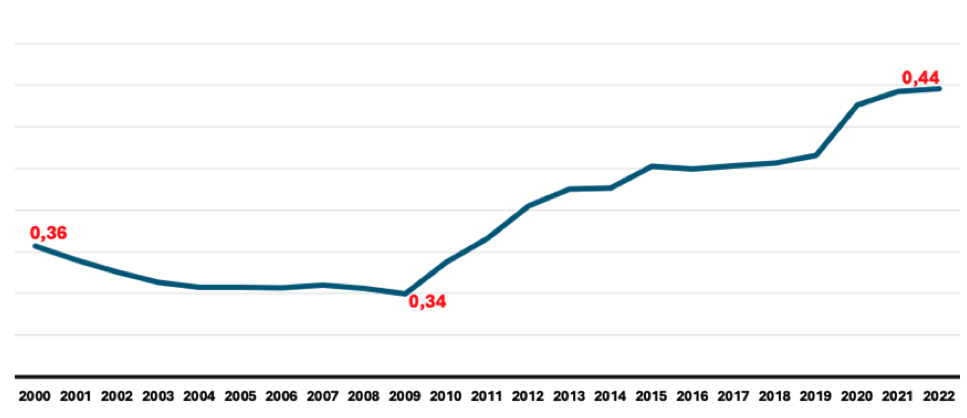
Chart 4: Inequality in income pro capita amongst EU Regions (standard deviation,2000-2022)
Source: Vision on Eurostat data
The chart shows over the last fifteen years, that the differences amongst EU regions are increasing. This is particularly disturbing evidence because the EU treaties consider it a fundamental priority of the union to gradually decrease gaps amongst regions. In fact, one third of the EU’s budget is dedicated to cohesion policiesthat are meant to make less developed regions to converge towards averages. Inequalities are on the rise, and it is not about territorial gaps. Angela Merkel was both proud and worried about the EU being the “welfare superpower”.
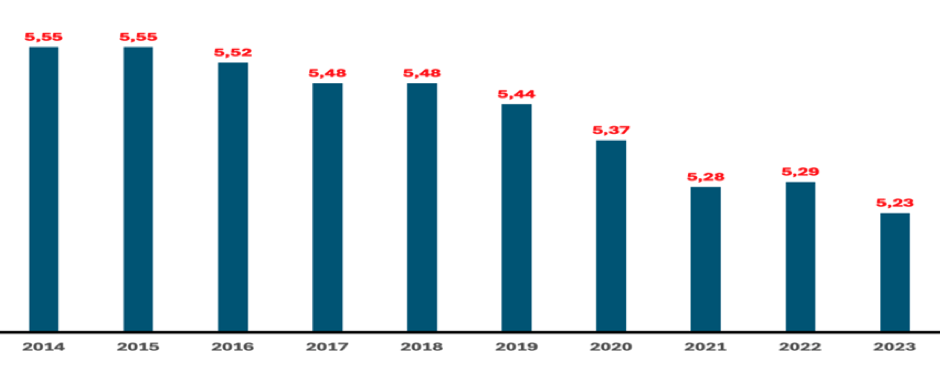
There is however another, wider “ugly” issue that EU will need to handle as part of a “world order” that is disintegrating. It is true that Europe still enjoys freedom and yet such “openness” does not any longer automatically translate into ever increasing prosperity. If we try to map countries of the world for their democracy index vis-à-vis their economic growth, we end up having rather strong negative correlation both amongst developed and less developed countries.
This reduced efficiency of democracy may be the stronger explanation to the “crisis of democracy” that most analyses seem to show.
Chart 5: Evolution of the Democracy Index worldwide (from 0 to 10, 2014/2023)
Source: Vision on Economist intelligence Unit data
Vision argues that it is not true that democracy is structurally less efficient than autocracies. After all, liberal democracies dominated the nineteenth and twentieth centuries also because they proved more productive than their autocratic rivals. Yet we will need to rethink the forms of democracy so that they will regain an information advantage.
The question of democracy is arguably the one that has got the most potential to provide the (intellectual and governance) instruments we need to navigate into the “unchartered waters” of a century that started 24 years ago. Yes, the EU will need more integrations like the ones that recent reports (like Draghi’s one) suggets, but these logically require better engagement with the public so that they can still feed policies with their individual intelligence.
The EU may even turn its old fragilities into flexibilities that complexity is asking for. This is the intellectual, political and managerial challenge that one think tank,three universities and five politicalfoundations will try to handle at the conference and beyond.
This study was conducted by
Francesco Griilo, Vision Director
Valerio Rosa, Vision Associate
Jing Wang, Vision Associate
Chiara Mezzogori, Vision Associate