Data, Public Policies, and Market Failures Behind the European Housing Paradox
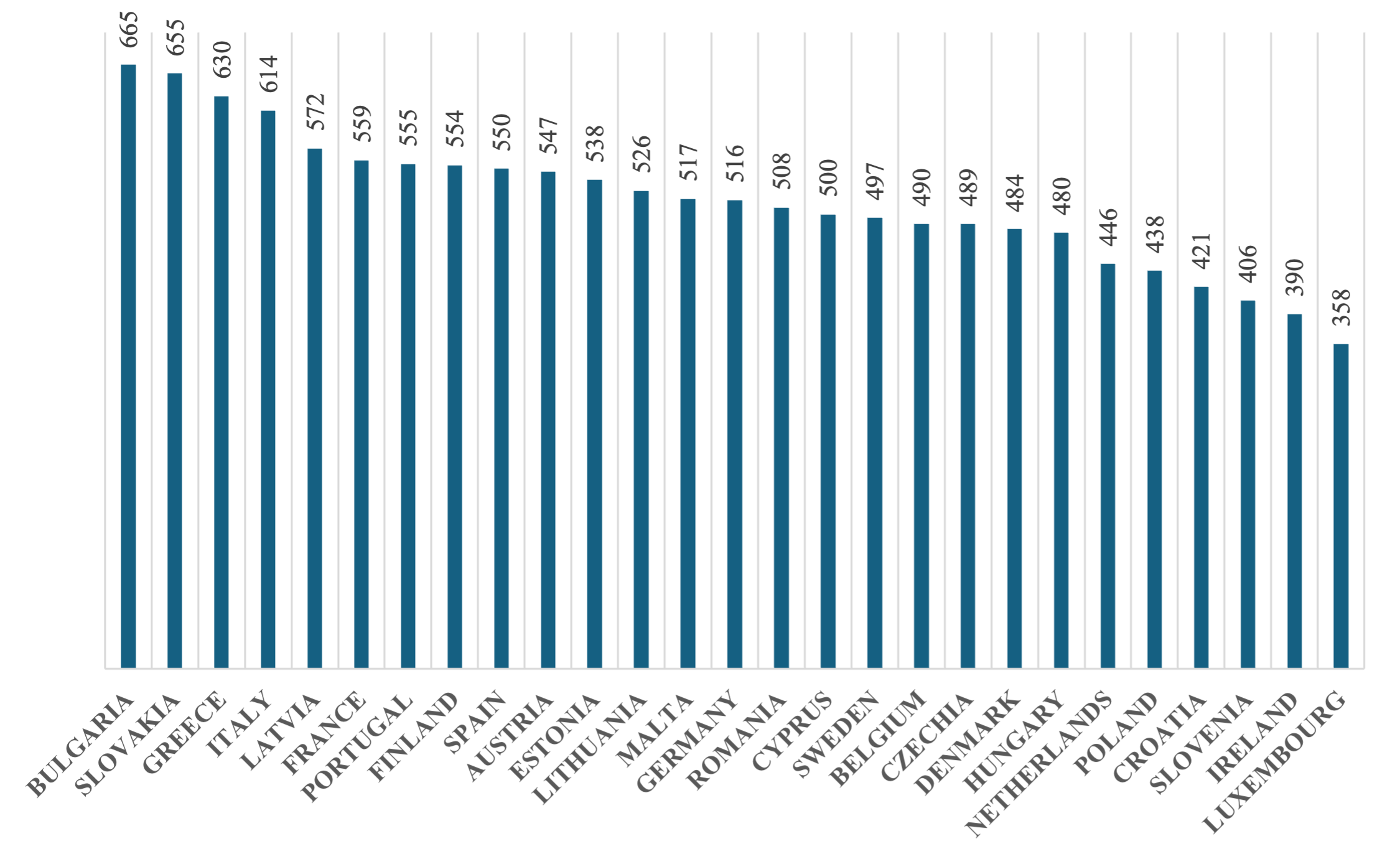
According to the most recent data, the European Union counts approximately 239,814,585 dwellings, representing the total stock of residential units available for occupation. At first glance, this figure suggests a substantial housing supplyrelative to the size of the Union’s population. When related to the EU population of around 450 million inhabitants, this corresponds to more than 530 dwellings per 1,000 inhabitants, indicating that, in aggregate terms, the availability of housing units exceeds what would be required to accommodate the population on a one-to-one basis.
Number of dwellings per 1000 inhabitants by Member State (2025)
Vision on Eurostat data
Alongside this, the issue of homeownership emerges, historically perceived as a source of security and national pride, but also partly limiting the capacity for innovation and economic growth. In Italy, 76% of the population lives in owner-occupied housing, a share significantly higher than in major European economies. In Germany, 47% of the population owns their home, while in France the percentage is 61%. The gap widens further when considering homeowners without a mortgage. In Italy, 63% of homeowners are mortgage-free, compared to 24% in Germany and 30% in France..
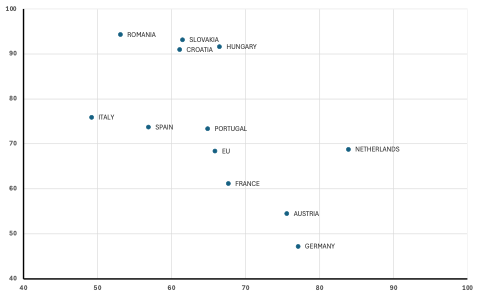
Countries with the highest homeownership rates in Europe include Romania, Slovakia, and Hungary. However, a high level of homeownership does not necessarily indicate a country’s capacity to generate wealth.
The following chart shows that the four countries with the highest ownership rates, all above 90%, are Romania, Slovakia, Hungary, and Croatia. These countries have economies characterized by structural fragility, lower household incomes, and limited social mobility. In this context, a high share of homeowners can also signal a lack of alternative investment instruments or restricted geographic mobility, which tends to concentrate wealth in real estate rather than distributing it across productive sectors.
Homeownership rate (vertical axis, in %) and youth employment rate (ages 20–29, horizontal axis, in %) in major EU countries (2024)
Vision on Eurostat data
A more detailed perspective emerges when examining the situation of the four largest European capitals. The housing stock of Madrid, Paris, Berlin, and Rome shows a surprising quantitative abundance relative to the resident population. Paris, with just over 2 million inhabitants, counts approximately 1.394 million dwellings (0.7 per person); Rome records 2.241 million units for 2.64 million residents (0.85 per person); Madrid has 1.533 million dwellings for 3.25 million citizens (0.47 per person); and Berlin exceeds 2.059 million dwellings for 3.42 million inhabitants (0.60 per person).
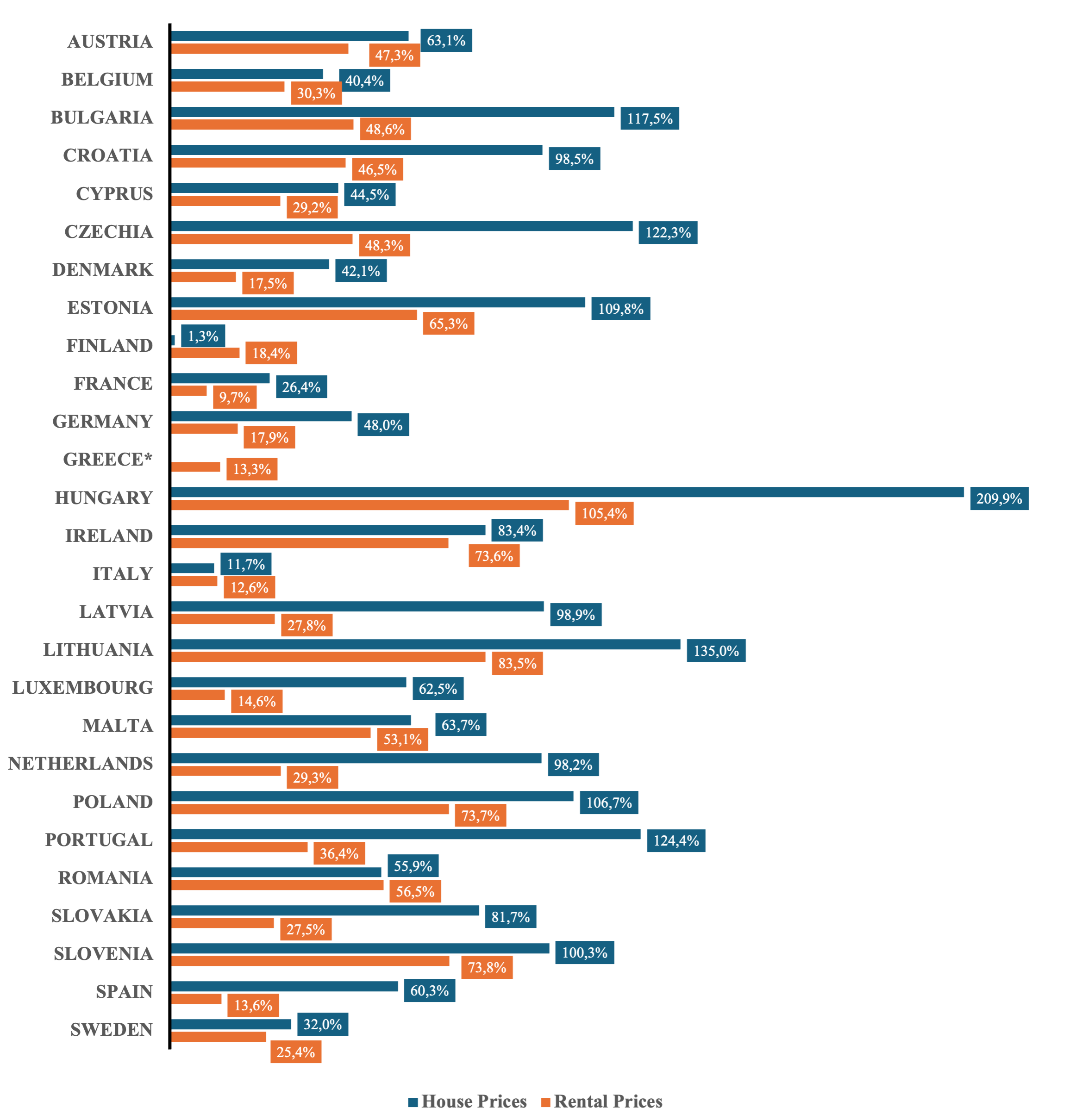
This apparent abundance is not reflected in either purchase prices or rents, both of which have followed an almost continuous upward trajectory since 2015. Property values and rental rates have increased in all the capitals analyzed, to varying degrees, while the phenomenon of vacant housing highlights structural problems of underutilization of the housing stock. At the European level, a significant share of homes remains unused, often concentrated in less attractive areas or allocated to non-traditional uses, thereby contributing to price pressures and making the effective availability of housing much more limited than it appears.
Increase of House Purchase Prices and Rents in EU Countries (%, 2015-2024)
Vision on Eurostat data
In 2025, the European Union launched the First European Plan for Affordable Housing, structured around four pillars: increasing housing supply, mobilizing capital, managing housing emergencies, and supporting the most vulnerable groups.
However, the resources available are limited compared to the estimated needs, and EU initiatives tend to alleviate symptoms rather than address structural causes. In this context, three complementary strategies can contribute to more effective intervention: regeneration and redevelopment of existing urban housing stock, activation of vacant dwellings and improvement of rental market functioning, and population redistribution towards inland areas and smaller centers through infrastructure, services, and digital innovation. The EU’s role as a knowledge manager can facilitate the exchange of experiences and replicability of best practices, supporting integrated and targeted projects capable of turning the housing crisis into an opportunity for urban regeneration, social cohesion, and sustainable development.
This paper is conceived as a starting point for a problem-solving exercise, designed to involve all major actors in the housing system: European institutions; national and local governments; the banking system and real estate companies; and the public and consumers.
The study was conducted by:
Francesco Grillo, Vision Director
Dario Dell'Otti, Vision Associate