
The treasure of Congo.
The author of the paper is Francesco Grillo and adaptation by Marina Obba.

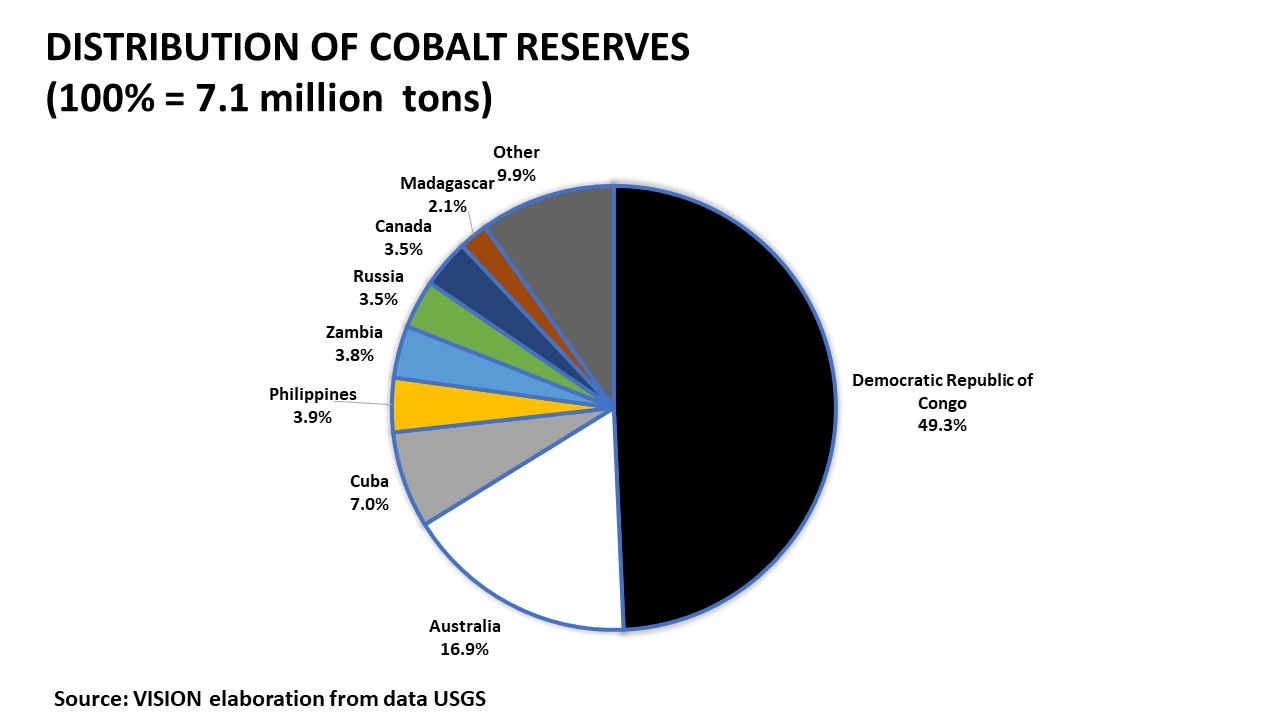
Despite general overlook, Apocalypse Now, one of the hallmarks for cinema in the eighties, was actually inspired by a previous book written at the end of the 19th century by the Polish-British writer, Joseph Conrad. In Heart of Darkness, the narrator navigates through the wonders of the ascent Congo River. Along Along the pursuit of the young ivory trader known as Kurtz, Conrad manages to draw a brilliant and ingenious parallel between the center of the West, London and the heart of Africa. Congo is today the place where an ancient past and a likely gateway to new unknown horizons converge. Within its territory, DR Congo holds one if not the most important mineral for the ecological and digital transition that the world so devoutly is looking forward to. In fact, that nearly half of the global cobalt reserves rest in the country, is no less than instrumental to understand continued instability and violence at the center of the most ancient continent.
Two hundred billion dollars. This is the estimated value at current prices for the reserves of cobalt that Congo – a country of one hundred million inhabitants and one of the biggest surface areas in the world – holds in its mines. And still, the numbers from this vast heritage could be largely underestimated, hiding enormous potential. Despite Tesla’s attempts to reduce its dependence, together with lithium and nickel, it is undeniable that cobalt is an indispensable material for rechargeable batteries for countless items such as smartphones, cardiac-pace makers or electric cars which by the way point to take over fossil fuel powered cars in a future that is not that far. Moving beyond speculative bubbles, cobalt will be one of the great financial trends - just like tesla or bitcoin prices – having the potential to truly change the world. Already, in just two months from the beginning of the year its prices have almost doubled on the London stock exchange in the trading of metals (LME).
Some even say cobalt is the oil of the twenty-first century. And yet, right next to this future valuable asset, starvation and violence persist. Bullets are more easily found in the heart of Africa than drinking water.
Since King Leopold proclaimed himself the ruler of the DR Congo, the country has been practically under darkness, just like in Conrad noted. Unfortunately, as it often occurs in the continent, the only period of relative peace were the thirty years dictatorship. In these years, Mobutu, even managed to bring to Kinshasa (the capital) the most famous events in the history of boxing, the match between George Foreman and Muhammad Ali.
Nonetheless, since Mobutu’s death, the Eastern part of the country has remained a war zone. A few years ago it was invaded by groups from neighboring nations and civil wars have broken out between different ethnic groups. Added to other important minerals such as coltan, copper and diamonds, the search of the Holy Grail cobalt has translated into a kind of ‘everyone against everyone’. It is a bit like in distant Libya where there is potential to raise living standards and live well but is a place where, instead, no one controls anything anymore.
Yet, in Congo, as in the rest of Africa, the withdrawal of Europe - and the United States- has proved as when a gas disappears: before it leaves, its already occupied by the new superpower. China, already enjoyed the advantage of controlling 90% of the supply of rare minerals gearing the green and digital economies. Owing to this experience, mines in the south of the country are controlled by a multinational from the Eastern province of Zhejiang. In Congo, the average income does not reach two dollars, but the worst comes for mine workers - or creuseurs in the language of the first colonizers-, and most of them are children. Over the past years, several lawyers within the Federal Court in the U.S have launched lawsuits against the giants of Silicon Valley using ore in processors, claiming the rights of diggers, whose bodies hold tales of unspeakable suffering.
But what should be done? The assassination of Luca Attanasio is one of the many who have suffered the instability in the country, and if nothing is done, the many that will suffer it too. So, what is it that will consolidate the development processes that are still unstable, undemocratized and most importantly, fragile?
One way is that of seeking aid, from the rest, from programs such as the World Food Program one that Luca followed into the heart of the jungle. However, on this point, it would be efficient to enhance even more so the non-governmental organizations of doctors and volunteers, who, regardless of the protection of blue helmets grant their time in situations like this. Of course technical assistance is also key, and in this regard, no one does as much as the European Commission. Giving assistance to governments that try to build minimal infrastructure and helping small and medium-sized enterprises to some countries; for instance, Nigeria that are additionally capable of great technological innovations.
And, still, we believe the real test for the Europe of the future is to find levers for 'safety' without which the energy of so many can be swallowed up by darkness.
After the failed attempt to export democracy in the deserts in the Middle East a few years ago, no one recalls this option. At the same time, Europe must also be able to support the bravest governments with its own police and intelligence apparatus. Therefore, the remaining option is to commercially isolate those who are responsible for large-scale abuses.
The future of our security and human rights charters is not only built with rhetoric and relatively useless conferences. Defending values and ourselves means taking risks and taking decisions. We believe that only in this way can we honor the courage of those who risk their lives in the places where life was born. After all, it is mostly in the darkest hours that we can imagine new perspectives.