Siena Conference 2026: concrete proposals for “pragmatic federalism”.
An article of Francesco Grillo for La Repubblica
Between French algorithms and dependence from the United States, the Siena Conference on the Europe of the Future puts forward concrete proposals for a "pragmatic federalism" which begins with energy, defence and the digital euro.
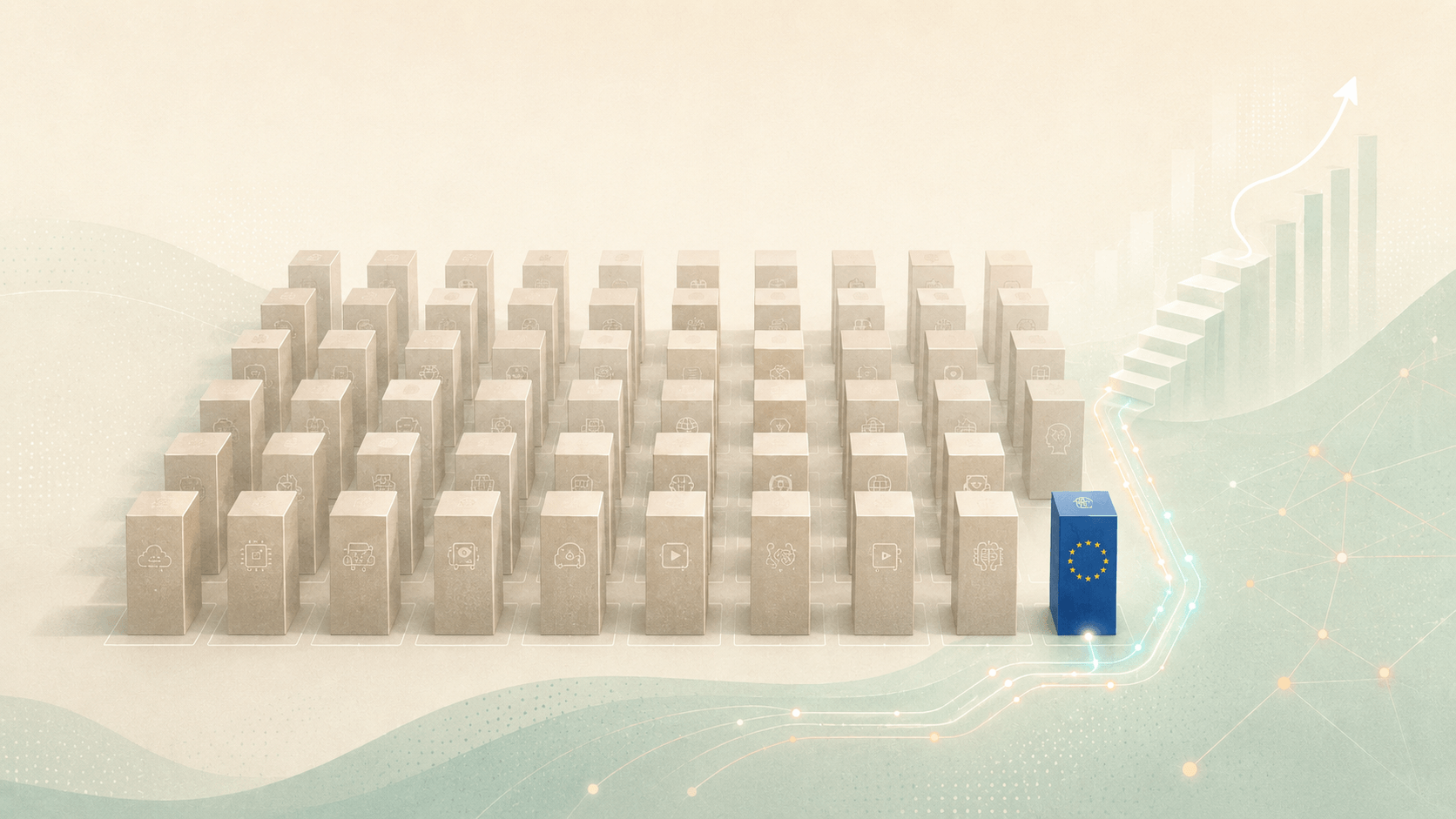
Only one of the world's fifty largest companies by market value comes from an EU country: the Dutch firm ASML, global leader in the machines for chips production. Only one of the 27 major platforms serving European consumers and regulated under the EU's Digital Services Act is European: Zalando (from Germany). And only three of the 62 large language models powering the rise of artificial intelligence are produced by European companies (all three of them are French).
These three data, which opened the Conference on the Europe of the Future held in Siena over the weekend, are enough to sound the alarm. Europe may still rightly claim to be the continent where quality of life is highest. But the future is slipping out of its hands. In Siena, around one hundred participants (politicians from across the political spectrum, managers, entrepreneurs, students, academics, journalists and representatives from across Europe) gathered to identify ideas capable of reversing this decline. The goal was to define a way of responding to crises that can no longer rely on the post-Cold War assumptions of the twentieth century, and to escape a structural dependency — in digital technologies, defence and energy — that makes Europe fragile.
A series of concrete proposals emerged from the Siena conference, pointing to a third way between opposing ideologies that have confronted one another for years without solving a single problem. On regulation — often accused of burying any attempt at innovation under a flood of unnecessary compliance burdens — one proposal is to measure people's and small businesses' actual ability to understand and use rules, and to make that capacity the criterion for deciding how rules should be written and which ones should be kept.
On defence, a pair of Ukrainian startups showed in Siena how it is possible to defend itselves better while spending less — and why NATO's call to raise defence spending to as much as 5% of GDP may be conceptually misguided.
On energy, Vision Think Tank, together with the Italian company ERG, presented a method based on four indicators to assess how the energy transition is progressing and where Europe must accelerate in order to become less exposed to future crises.
On digital policy, the conference is developing a proposal to speed up the introduction of a digital euro and stablecoins capable of making payment systems less dependent on American networks, while also attracting capital toward securities issued by the European Commission.
Equally interesting are Vision’s proposals on cohesion policies for less developed regions, as well as those put forward by the Invernizzi Lab on agricultural policy at SDA Bocconi. Both move in the same direction: grant-based and subsidy-driven approaches should gradually be replaced by partnerships in which the public and private sectors invest together and are assessed against clear, measurable objectives.
Even more important, however, is the model of European governance proposed in the conference. Both the ideology that imagined the United States of Europe as the result of an inevitable, top-down integration process, and the ideology that would return us to nation-states, belong to other centuries — and to other generations. The "pragmatic federalism" approach suggested by Mario Draghi must now be made explicit.
In Siena, a team of students and professors from LUISS launched an important discussion, joined by The Economist and many other conference participants. In the future, on major areas of integration — defence, digital policy and energy — Europe can no longer wait for the last of 27 member states with the power to block decisions on issues that determine whether the continent has a future at all. Progress will have to come through groups of countries, potentially even beyond the current borders of the European Union, that decide to pool resources and capabilities without opportunism. Citizens must be involved in ways that make these unions stronger. And the system must allow both for the exit of those who change their minds and for the later entry of those who decide to join.
What comes out of Siena is a "third way". The destructive drift that risks disintegrating the Union, and with it the few tools we still have to manage increasingly severe crises, is extremely dangerous. But just as dangerous is the idea of retreating into a rhetorical defence of a status quo that simply no longer exists. Europe will need places where the future can be imagined while recovering a sense of historical memory. Places like Siena.