
As the fourth edition of the Siena Conference on the Future of Europe is approaching (8-10 June 2023), Vision is organizing four webinars to start the conversation on the topics that will be addressed by the "problem-solving groups" during the Conference. The first webinar is going to be held on 8th May, at 5pm CEST, and it is going to address the following topic: "The EU as the lab for experimenting innovations to save liberal democracies from decline."
HERE you can find the link to follow the webinar on 8th May.
In order to prepare for the webinar, here is some background information (PDF version)
European democracy has been for four years in a row one of the key questions around which Vision conferences on the future of EUROPE have developed. It is so because it seems natural to think that a more efficient Europe (one which is capable of deciding more quickly vis-à-vis ever more frequent emergencies) needs to derive more than its “power” directly from European public opinion and a Europe-wide debate, which is still largely missing.
Many polls have consistently shown that European institutions continue to be “disconnected” from citizens; and yet the most interesting evidence of this is the evolution of the turnout at the European Parliament election (EP), the institution meant to provide a direct link between EU institutions and citizens (and still the only supranational assembly directly elected by citizens of sovereign States).

The paradox is that turnout has progressively gone down, while the power of the EP has gradually been increased, the only exception being the last 2019 election, and yet that was the election in which the vote for parties which appear not to be in favour of a “federalist” view of the EU reached its highest (31% of the total votes).
Such evidence appears to suggest two changes into the approach to the large question of how to bring “Europe closer to its citizens”. The first is that we should no longer focus on the old, unresolved issue of the so-called “European democratic deficit”; the European Union should not replicate mechanisms which appear to be suffering at the national level and it should be seen as a possible laboratory to experiment the innovations we need to make liberal democracies work in a century which is very different from the ones in which the present political model was invented. The second is that any attempt cannot move from a “federalist” point of view: we need more democracy for Europe and the shape of European institutions to flexibly reflect European citizens' opinions and needs.
The thesis that VISION is proposing to the “SIENA CONFERENCE ON THE FUTURE OF EUROPE” is that the crisis that we are witnessing is not a decline of democracy as such but more about the obsolescence of the instruments that liberal democracies have used for decades to reflect the opinions of citizens in policy making . As for the chart below, the idea is that what made liberal democracies outperform their autocratic competitors was their superior capability to make decisions based on information. Today some technocracies have the advantage of quicker decisions, as the internet lessens the information disadvantage; whereas smaller liberal democracies are experimenting tools to update participation mechanisms.
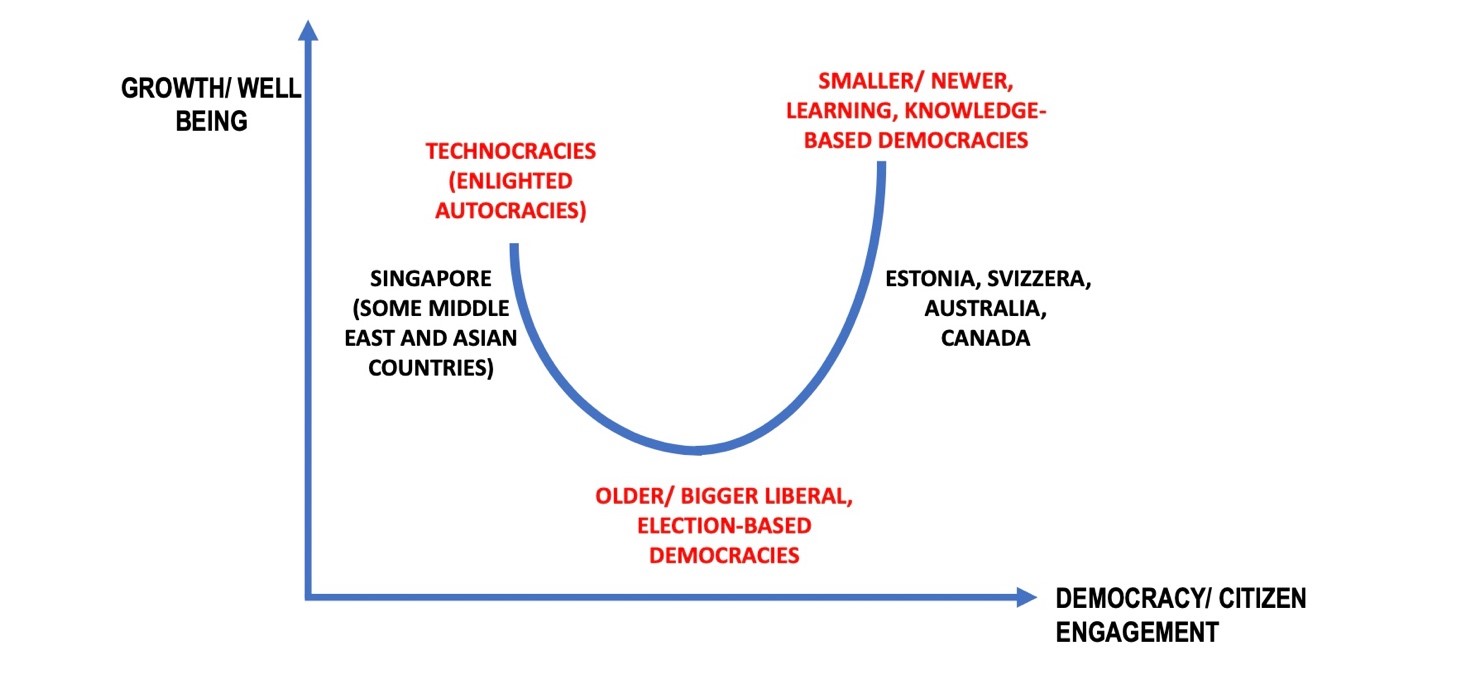
1 The thesis is that the crisis ultimately comes from a widening gap between the quantity of information we can access, elaborate, and transmit and the tools (elections every four years, binary referendums, etc.) we still use to make people participate. The former increases the expectation of individuals to have their opinions taken on board; the latter act as a bottleneck creating frustration. Such an interpretation of the crisis of liberal democracy draws on a comparison between the printing machine in the Middle Ages and the Internet in the twenty-first century. They both hugely reallocated information and thus power and therefore they both had as a direct consequence a transformation through which power was acquired and exercised. The printing machine started a revolution ending with the end of absolute monarchies and the birth of liberal democracies; the Internet will demand liberal democracies to reinvent themselves to survive technological obsolescence.
This brings us to propose the idea that in order to save democracy, we must increase it and make it deeper and more information-rich. And have Europe become forerunners of the process. Citizens’ assemblies as a participatory democracy tool that the “Conference on the Future of Europe has promoted”. Electronic voting as an enabler of more frequent and informed participation in the deliberation process. Flexible constituencies that take in account that citizenship may not be necessarily bound to a specific geographical area (as for Vision’s proposals on “flexible transnational constituencies”). Europe-wide referendums with more than two possible answers. These may be some of the experimentations that Europe may pioneer and of which the conferences may discuss the feasibility.
SOME REFERENCES:
- Auer A., Mendez, M., (2005). Introducing e-voting for the European Parliament elections: the constitutional problems. In Trechsel A.H., Mendez F.(Eds.), The European Union and e- voting: addressing the European Parliament’s Internet voting challenge, Routledge, New York, 125;
- Barcevičius, E., Cibaitė, G., Codagnone, C., Gineikytė, V., Klimavičiūtė, L., Liva, G., Matulevič, L., Misuraca, G., Vanini, I., (2019). Exploring Digital Government Transformation in the EU, JRC Science for Policy Report, European Commission;
- Boucher, P. (2016). What if blockchain technology revolutionised voting? European Parliament Think Tank, available here;
- Hennen, L., van Keulen, I., Korthagen, I., Aichholzer, G., Lindner, R., Nielsen, R.Ø., (2020)., European E-Democracy in Practice, Springer Open;
- Trechsel, A. H., Kucherenko, V.V., Ferreira Da Silva, F., (2016), Potential and challenges of e-voting in the European Union,European Union Democracy Observatory (EUDO) Report, 2016/11;
- Vassil, K., (2015). Selected Behavioural Evidence on Estonian Internet Voting, University of Tartu.