Causes and solutions to avoid implosion
Paper by Francesco Grillo and Claudia De Sessa expanding Francesco's column published on the Italian newspapers Il Messaggero e Il Gazzettino del Nord Est
Scan of paper edition

“The greatest challenge for a democratic country is keeping government expenditure under control”.
Nobel prize winner Milton Friedman was, possibly, one of those who managed to best capture one of the greatest paradoxes of history. Since mid-eighteen century, when philosophers started to see in the great accumulation of private capitals one of the main drivers of history, the only unstoppable trend seems to have been the accumulation of public debt by capitalist economies. This, up until the explosion that occurred during the pandemic. Complex societies require public intervention, however, if public debt continues to rise we may find ourselves in a situation where the economy is not even capable of funding the state anymore. This is the great paradox that needs to be deconstructed and understood, in order to better gauge the causes and dangers it poses.
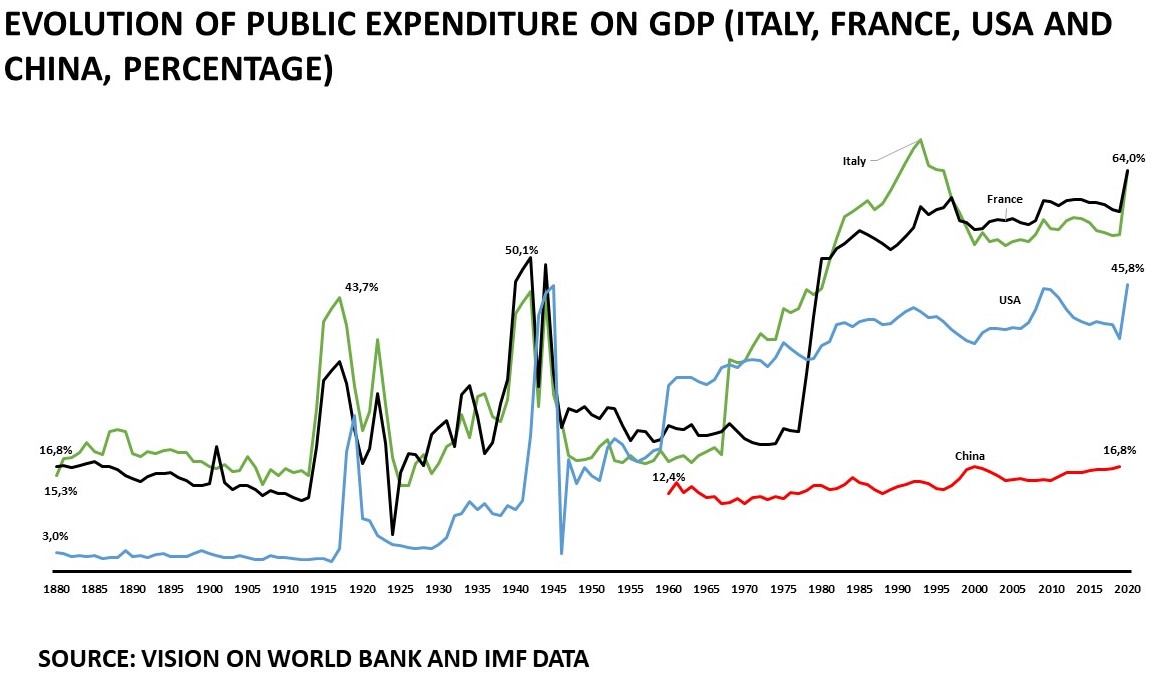
According to data collected by the university of Oxford in 1880 – when Europe and the US were going through the Great Industrial Revolution and Carl Marx was starting to talk about capitalism – the state was spending around 9% of GDP in England and 3% in the United States. Fifty years later, in reaction to the Wall Street Crash of 1929, President Roosevelt under Keynes advice ventured into a public investment program that increased that percentage up to 11%, making history. Compared to today, the then never before seen amount of public investment is five times smaller than the amount the US will reach in 2022. Joe Biden’s plan proposal will indeed cost around 2.400 billion dollars and it will push the administration into spending more than it did to fund World War II.
For many - especially Southern – European countries, the situation is similar. In Italy, at the beginning of the 80s, during the First Republic, public debt was around 60% of GDP. PM Amato and then Monti had to implement painful austerity measures in order to tame an ever-rising debt, that kept spiraling up to 120% in 1995 and then 135% in 2015. Today, public debt is over 160%. Paradoxically, in proportion to their own economies, communist governments such as China and Vietnam spend less (around little under 40%).
The reasons for which the rise of public debt is irresistible in liberal democracies are – according to the Economist who this week devoted an article to the topic – essentially, three:
The influence of bureaucrats who are the lobby closest to decision and law makers and that tend to orient decisions towards choices that increase their power and purchase power.
Voters, who would obviously reward bigger spending if it was directed towards special group interests but that do not feel impacted by taxes that affect everyone.
Lastly, the fact that government expenditure concerns services – such as healthcare and education – for which demand increases but where it is hard to increase productivity.
A doctor cannot increase the number of patients he/she visits in one hour, while a worker can absolutely increase the number of pieces he produces in the same timespan. Indeed, all three of these factors can be defused utilizing, cleverly, technologies and flexibility.
Starting from the last two: it is no longer true that the productivity of public services is necessarily flat. The pandemic is showing us that – just like with music – the competence of the best surgeon or the best math lesson can be incorporated in remote working robots and duplicated an infinite number of times, to the benefit of an illimited number of patients and students. The pandemic is also showing us how it is possible to monitor, in real time, the health conditions of old people and intervene in order to avoid hospital overcrowdings.
Secondly, voters. If only we could align the benefit perception of a new expense with the value it has in terms of increased taxes, we could improve the quality of government expenditure and of democracy itself. This is already happening in Vancouver, Canada, where popular assemblies draft the municipal budget. The evaluation of a bridge construction is pondered collectively and very few people would choose to burden their children with debt, if the project cannot prove to repay itself in terms of costs and growth for everyone.
Lastly, bureaucrats. Again, the pandemic shows us that, perhaps, we have reached the end of a whole way of understanding the job market and public administration. An increased revolving door phenomenon – that already exists in France and that brings state servants in the private sector and vice versa – would discourage the unhealthy tendency of public servants to occupy and expand often inefficient or anachronistic jobs.
Of course, we need and will continue to need the State. And we also need more politics to regulate the technology that could even increase the productivity of hospitals and schools. If, however, government expenditure would continue to rise, it could bring towards an economy too dependent on the State and that would risk imploding. This is all the truer for countries such as Italy, that needs to handle a transformation plan (PNRR) without being able to increase – as the European Commission warned a couple of days ago – its normal expenses.
These are times that bring with them a redefinition of the concept of State and of the market that nor old socialists not pure liberals would recognize. The “Leviathan” that dominates the world is a weird animal that needs, however, to absolutely reduce in time its dimension and increase its intelligence.
One very fundamental element that doesn’t need to be overlooked is also that, although technologies have the potential to structurally change certain sectors, they are nothing but a tool in absence of proper, politically strong planning. So, before resorting to complex AIs, we need to ask ourselves the question of how to reform a system that grimly forced policy makers to ask, during the pandemic “should we prioritize human lives or the economy”.
First of all, administrations need to reprioritize access to public goods and services. This cannot, however, be achieved if countries do not tackle pre-existing issues such as effective reform of public administration and monitoring of the quality of public investments. A greater involvement of the European Union could perhaps provide a push towards better access to public goods and services and increased efficiency of the public administration.
In a 2020 study, the EPRS( European Parliamentary Research Service) explored the concept of wasted budgetary resources, meaning assessing the long-term net additional potential economic cost of policies administered in a fragmented way at the Member State level, or not implemented at all, relative to a situation where some of these policies are administered or coordinated at EU level. In other words, to what extent the aggregation or coordination of budgets, oversight and competences at EU level generates additional added value and saves resources.
This aggregation would translate in increased provision of public good and services; better use of existing limited resources (ensuring three forms of efficiency gains: productive, allocative, and dynamic efficiency); integration of economic impact of externalities and positive spillover effects. The results of the study highlighted how the average waste reduction potential (€ billion per year) deriving from aggregation was (€ billion per year): 20,5 in the Health sector, 50 for Climate change, 64,5 for Social insurance and 45 for Defense. The study also highlighted the current waste related to inefficiency in the same sectors, with results that showed great heterogeneity in the level of efficiency of investments and PA in different EU Countries.
The EPRS then follows with recommendations like focusing on common EU spending for procurement (saving up to €17billion) and prevention (saving up to €3.5 billion) in the Healthcare field, proposing European centralized insurance schemes for unemployment, given the heterogenous and often poor performance of member states and then highlights the costs related to duplication of operations in the field of Defense.
Rethinking public expenditure strategies at the European level thus seems crucial, not only to optimize what we have, but to develop a common strategy for the future that will allow us to thrive and navigate this new world.